The global hair dryer market is expanding, but supplier quality remains uneven. Grand View Research estimates that the market reached approximately USD 9 billion in 2023. Its report also projects steady growth through 2030, supported by professional styling demand and household appliance upgrades. These figures explain why China remains a major sourcing destination.
This guide introduces China’s top 10 Dual Voltage Hair Dryers suppliers for importers, distributors, hotels, and beauty retailers. The selection considers manufacturing experience, export records, product engineering, and quality-control procedures. It also examines wattage stability, motor performance, overheating protection, noise levels, and available attachments. Practical details matter. A reliable dryer should switch between 110–120V and 220–240V without unsafe manual modification.
Certification is only one part of the assessment. Depending on the target market, buyers may need CE, UKCA, FCC, RoHS, or other applicable compliance documentation. Intertek and SGS testing can strengthen confidence, but documents should be verified against the exact model. Grand View Research and Fortune Business Insights both identify product innovation and energy efficiency as important market trends. However, supplier websites often present polished claims without enough factory evidence.
No supplier is perfect. Lead times can shift. Sample performance may differ from mass production. That is why this overview encourages factory audits, sample testing, production inspections, and written warranty terms. The ranking is a practical starting point, not a final purchasing decision. Buyers should still compare quoted specifications, minimum order quantities, packaging quality, spare parts, and after-sales support before signing contracts.
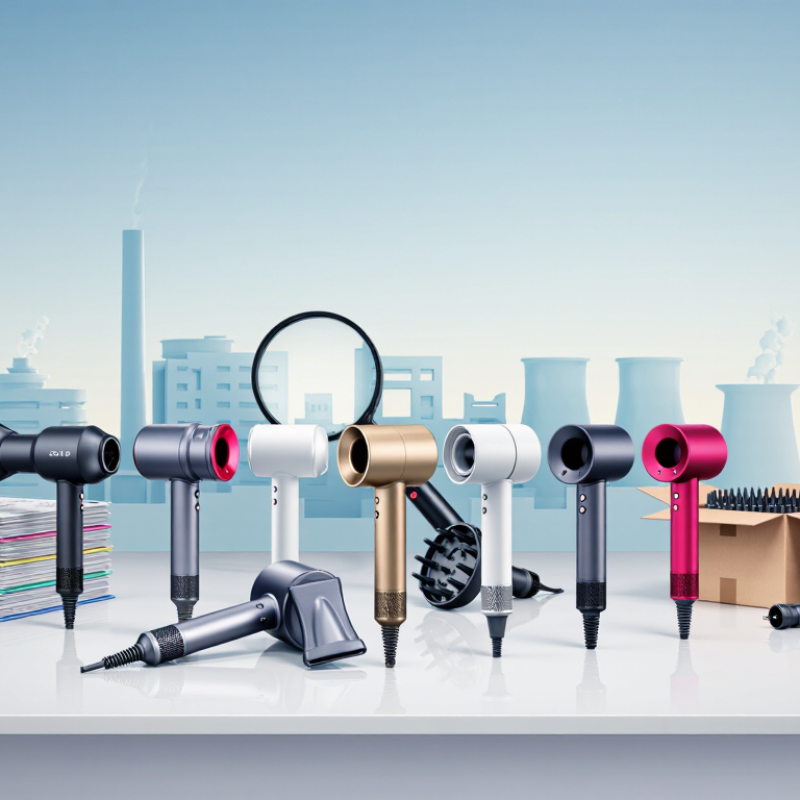
Dual-voltage hair dryers are designed for international use, usually accepting 100–240 V and 50/60 Hz. This range supports common household systems across many regions. However, the printed range does not guarantee identical performance everywhere.
Some units switch voltage automatically. Others require a small voltage selector. That difference matters during travel. At 120 V, a 1,800 W dryer draws about 15 amps. At 240 V, it draws roughly 7.5 amps. Actual output may change with the selected voltage, airflow setting, and motor design. A suitable plug adapter may still be necessary.
Suppliers should provide clear electrical labels, user instructions, and test evidence. Ask for thermal-cutoff details, insulation checks, and continuous-operation results. A 1,200 W model usually feels gentler and may dry slowly. A 2,000 W model offers stronger heat and airflow, but it can demand more from hotel circuits. That trade-off is easy to overlook.
For sourcing, compare measured drying time, noise, cord flexibility, and heat stability. Do not judge quality from wattage alone. I would also check whether the voltage selector feels secure, because loose switches create unnecessary uncertainty. Product documents can look complete while missing frequency information. That is a warning sign. A careful supplier explains those gaps instead of hiding them.
| Rank | Anonymous Supplier Profile | Voltage Configuration | Frequency | Typical Rated Power | Voltage Selection | Motor Category | Heat Settings | Protection Features | Key Verification Documents |
|---|---|---|---|---|---|---|---|---|---|
| 1 | Profile A — Travel-focused OEM | 100–240 V | 50/60 Hz | 1,200–1,400 W | Automatic | DC travel motor | 2 heat / 2 speed | Overheat cut-off | Safety test report, wiring diagram, plug approval |
| 2 | Profile B — Compact folding dryer | 100–240 V | 50/60 Hz | 1,200–1,600 W | Manual or automatic | DC motor | 2 heat / 2 speed | Thermal fuse | Material declaration, EMC report, user manual |
| 3 | Profile C — Ionic styling model | 100–240 V | 50/60 Hz | 1,600–1,800 W | Manual selector | AC motor | 3 heat / 2 speed | Thermostat and thermal fuse | Ion-generator test data, electrical safety report |
| 4 | Profile D — High-airflow salon model | 110/220–240 V | 50/60 Hz | 1,800–2,000 W | Manual selector | AC motor | 3 heat / 2 speed | Thermostat protection | Rated-power test, noise test, plug and cable report |
| 5 | Profile E — Lightweight hotel dryer | 100–240 V | 50/60 Hz | 1,400–1,600 W | Automatic | DC motor | 2 heat / 2 speed | Thermal fuse | Casing flammability data, safety report, manual |
| 6 | Profile F — Diffuser-compatible dryer | 100–240 V | 50/60 Hz | 1,600–1,800 W | Manual selector | DC or AC motor | 3 heat / 2 speed | Thermal fuse and cool shot | Accessory compatibility test, EMC report |
| 7 | Profile G — Brushless motor model | 100–240 V | 50/60 Hz | 1,600–1,800 W | Electronic control | Brushless DC | 3 heat / variable speed | Overcurrent and thermal protection | Motor endurance data, EMC report, software or control documentation |
| 8 | Profile H — Wall-mount hospitality model | 220–240 V or 100–240 V | 50/60 Hz | 1,200–1,600 W | Model-dependent | DC motor | 2 heat / 2 speed | Wall safety switch and thermal fuse | Installation instructions, ingress assessment, safety report |
| 9 | Profile I — Low-noise personal-care model | 100–240 V | 50/60 Hz | 1,400–1,800 W | Automatic | Low-noise DC motor | 3 heat / 2 speed | Thermal fuse and cool shot | Noise measurement, EMC report, electrical safety report |
| 10 | Profile J — Premium temperature-control model | 100–240 V | 50/60 Hz | 1,600–2,000 W | Electronic control | Brushless DC or high-speed DC | 3 heat / variable speed | Thermal, overcurrent and sensor protection | Temperature test, motor endurance data, EMC and safety reports |
It usually accepts 100–240 V and 50/60 Hz. Performance may still vary by voltage, motor, and airflow setting.
No. Some switch automatically. Others use a small voltage selector. Check the handle before connecting power.
Often, yes. Voltage compatibility does not change the wall outlet shape. Bring the correct plug adapter for your destination.
A 1,200 W model usually feels gentler and dries more slowly. A 2,000 W model provides stronger heat and airflow.
It can demand more from hotel circuits. At 120 V, an 1,800 W dryer draws about 15 amps. At 240 V, it draws roughly 7.5 amps.
Request electrical labels, instructions, test reports, thermal-cutoff details, insulation checks, and continuous-operation results.
Ask for monthly output, active lines, utilization rates, and recent shipment records. An independent factory audit offers stronger evidence than a video call.
Compare standard and custom versions separately. Include tooling, packaging, spare parts, samples, payments, testing, and export preparation.
Testing should cover 100, 120, 220, and 240 V, plus applicable 50/60 Hz conditions. Check heat, insulation, leakage, plug temperature, and motor stability.
No. Verify report numbers with accredited laboratories and retain approved samples. Perfect paperwork can still hide weak production control.
This guide examines China’s top 10 Dual Voltage Hair Dryers suppliers and explains how to assess them beyond price alone. It introduces dual-voltage operation, including 100–240 V compatibility, 50/60 Hz frequency support, and typical power ratings from 1,200 to 2,000 W. Buyers will learn how to compare minimum order quantities, production capacity, lead times, customization services, motor designs, factory scale, and export experience across different supplier types.
The article also highlights essential safety and compliance considerations, including IEC 60335-2-23, CE, RoHS, and reliable 100–240 V testing procedures. A practical comparison framework covers unit pricing, warranty terms, defect rates, certification documentation, and after-sales support. By reviewing these factors together, importers, distributors, and private-label businesses can identify dependable manufacturing partners and select products that balance performance, safety, customization, and long-term commercial value.

 KangRoad Electrical