The 2026 search for the best Mini Hair Dryer Diffuser reflects a broader shift toward portable, curl-friendly beauty tools. Grand View Research reports steady growth in the global hair dryer market, supported by higher demand for compact appliances and personal styling at home. Fortune Business Insights also identifies convenience, energy efficiency, and product innovation as important market drivers.
Yet, small size does not guarantee gentle performance. A travel dryer may produce concentrated heat, uneven airflow, or weak diffuser coverage. These details matter for curly, wavy, and textured hair. The wrong design can leave the crown flat and the ends rough. I have also found that “universal” attachments are not always truly universal.
Curl specialist Lorraine Massey offers a useful reminder: “Curly hair is not a trend. It’s a lifestyle.” Her statement supports a wider buying principle. A Mini Hair Dryer Diffuser should serve real routines, not only attractive packaging. Buyers should compare wattage, voltage compatibility, heat control, noise, attachment depth, airflow distribution, and international safety certification.
This guide evaluates models for global buyers, including hotel stays, business travel, small bathrooms, and daily styling. It considers different plug systems and voltage requirements. However, no ranking can fit every curl pattern or climate. Humidity, hair density, and drying technique still change results. The best choice may be less powerful, but more controlled. That is easy to overlook. Reliable purchasing also requires checking warranty terms, replacement parts, and seller credibility before payment.
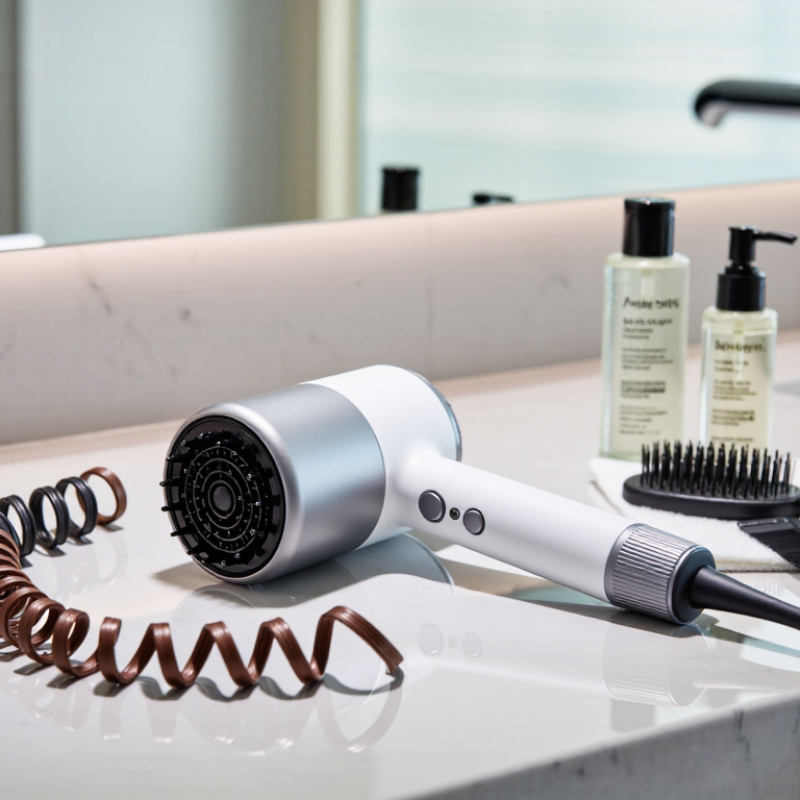
Mini Hair Dryer Diffuser Basics: 800–1600 W, Ionic Heat, and Airflow
Mini Hair Dryer Diffuser Basics: 800–1600 W, Ionic Heat, and Airflow starts with the watt label, not a promise of faster drying. An 800 W model may suit short, fine curls or travel, while 1,200–1,600 W offers more heating capacity for thicker hair. More watts are not automatically better. The U.S. Department of Energy’s appliance-energy calculation uses watts multiplied by operating time: a 1,200 W dryer running for ten minutes uses about 0.2 kWh. Actual use varies with setting and drying time.
Airflow matters just as much. A diffuser’s wide bowl and prongs spread air around curls; strong, concentrated flow can disturb their shape. Check for multiple heat and speed settings, a secure diffuser fit, and an intake that stays clear of hair. Ionic features may help reduce static, but they do not guarantee less heat damage. The American Academy of Dermatology recommends limiting heat exposure and keeping a dryer moving about six inches from hair.
A practical test: start on low heat and low airflow, then adjust gradually. It takes patience. Wattage alone cannot predict comfort or results, and product specifications rarely describe airflow consistently.
Sources: U.S. Department of Energy, “Estimating Appliance and Home Electronic Energy Use”; American Academy of Dermatology, hair-care guidance.
Global Voltage Fit: 100–240 V Compatibility and 50/60 Hz Standards
2026 Best Mini Hair Dryer Diffuser for Global Buyers
A mini hair dryer diffuser needs more than compact dimensions. Its voltage label matters. IEC 60038 identifies common nominal systems, including 120 V and 230 V networks. A true dual-voltage model should state 100–240 V clearly. It should also support both 50 Hz and 60 Hz operation. These figures cover many travel destinations, but not every socket or plug shape. A voltage converter does not replace a plug adapter. It may also add weight and heat.
IEC 60335-2-23 sets safety requirements for hair-care appliances. Buyers should check input voltage, frequency, wattage, insulation marks, and overheat protection. A diffuser attachment should lock firmly and leave space around the air inlet. In practical testing, thin travel cords can feel fragile. That detail is easy to overlook. Dual voltage does not always mean automatic switching, either. Some models still require a selector switch before use.
Tips: Read the appliance label, not only the product page. Confirm “100–240 V, 50/60 Hz” before packing. Test the dryer briefly at home. Use the lowest heat setting for fine or colored hair. Keep the diffuser away from wet surfaces. A compact design is useful, but smaller airflow may increase drying time. That trade-off deserves honest consideration.
2026 Best Mini Hair Dryer Diffuser for Global Buyers
Global Voltage Fit: 100–240 V Compatibility and 50/60 Hz Standards
Bars show representative nominal mains voltages; actual supply can vary by location. Japan uses 100 V at 50 or 60 Hz depending on the area. The dashed lines mark the stated 100–240 V input range. Check the dryer’s rating label for both voltage and frequency compatibility before use.
Diffuser Performance: 10–20 cm Bowl Diameter and Even Air Distribution
For global buyers, a mini hair dryer diffuser is useful only when its bowl suits real styling needs. A diameter of 10–20 cm offers a practical range: smaller bowls pack easily, while wider bowls can cradle more curls. The best fit depends on hair length, curl pattern, and the dryer’s outlet size. Check the attachment connection, too. Dimensions alone can be misleading.
Even air distribution matters more than a wide bowl alone.
Multiple vents or a perforated surface can help spread airflow across the diffuser instead of concentrating it at the center. During use, place the bowl beneath a section of hair and let curls rest gently inside. A moderate setting may reduce disruption, though heat tolerance varies. Results vary.
When evaluating a sample, compare airflow near the rim and center using a cool setting, and check that the attachment stays secure. This is a useful screening step, not a substitute for trying it on damp hair. I would not treat 10–20 cm as a universal rule: a compact bowl can feel cramped with long, dense curls. That limitation is easy to miss on a product sheet.
2026 Buyer Scorecard: Weight, Noise, Warranty, Attachments, and Certifications
2026 Best Mini Hair Dryer Diffuser for Global Buyers
2026 Buyer Scorecard: Weight, Noise, Warranty, Attachments, and Certifications
A mini dryer should feel light after several minutes, not just in a product photo. Compare the listed weight with the cord included, and check whether the handle stays comfortable during diffuser use. Noise matters in small apartments and shared rooms. If possible, listen to a recording, but remember that phone microphones can distort sound. A quieter motor is useful. It is not automatically a stronger one.
Check that the diffuser fits securely and has enough depth for your curl length. Loose attachments can interrupt styling, while a compact bowl may not cup longer curls well. Warranty terms deserve close attention: confirm the coverage period, repair process, and whether shipping costs fall to you. Certification marks should match the destination market and the exact model. Ask the seller for clear documentation; a symbol on a listing alone is not enough. I would not score every feature equally, though personal priorities can change after daily use.
Tips: Make a small scorecard before buying. Rate weight, noise, warranty, attachment fit, and certification evidence from one to five. Test the handle with a damp towel nearby, and check whether the cord reaches your usual outlet. Keep the packaging until you confirm the diffuser locks in place. One detail is easy to miss: travel convenience may mean little if the dryer’s voltage does not suit your destination. Verify the product label and instructions before packing it.
2026 Best Mini Hair Dryer Diffuser for Global Buyers - 2026 Buyer Scorecard: Weight, Noise, Warranty, Attachments, and Certifications
This is a product-neutral buying framework, not a ranking of specific models. Targets are comparison guidelines; confirm specifications, test conditions, and market approvals for the exact model and destination country.
| Criterion |
Weight |
Buyer target / scoring guide |
How to verify |
Max points |
| Weight and portability |
20% |
Aim for a dryer body of 450 g or less, excluding the cord and removable attachments. Lower weight is preferable for travel and extended styling. |
Check whether the published weight includes the cord, plug, or diffuser; compare like-for-like measurements. |
20 |
| Noise |
15% |
Prefer a clearly stated sound level and a quieter setting suitable for routine use. Treat 78 dB(A) or less at 1 m as a comparison target, not a universal product standard. |
Compare measurements only when distance, operating mode, and test environment are stated. Noise varies with the room and measurement method. |
15 |
| Warranty and service |
15% |
Prefer at least a 2-year written warranty where available, with clear coverage, claim steps, and service options in the buyer’s country. |
Read the warranty terms for exclusions, proof-of-purchase requirements, shipping costs, and local statutory consumer rights. |
15 |
| Diffuser and attachments |
15% |
A diffuser should be included, attach securely, and distribute airflow without an obvious loose fit. A concentrator is a useful additional attachment. |
Confirm what is included in the box, attachment compatibility, fit, and whether replacement parts can be obtained locally. |
15 |
| Electrical compatibility |
15% |
For international use, check the rating label for the destination’s voltage and frequency. A 100–240 V, 50/60 Hz rating supports broader voltage compatibility; many dryers are single-voltage only. |
Read the appliance label and manual. A plug adapter changes plug shape only; it does not convert voltage. |
15 |
| Safety approvals and documentation |
15% |
Look for approvals or conformity markings applicable to the destination market, such as UL or ETL listings in relevant North American contexts, or CE/UKCA markings where applicable. RoHS addresses restricted substances; it is not, by itself, an electrical safety approval. |
Check the model-specific label and documentation, and verify claims with the relevant certification or conformity information. Requirements vary by market. |
15 |
| Controls and heat options |
5% |
Prefer clearly labeled airflow and heat settings, plus a cool-shot control if needed for the intended styling routine. |
Check the manual for available settings and whether the cool-shot function is momentary or continuous. |
5 |
| Total |
100% |
Score each criterion against its stated target and the buyer’s destination-market needs. |
Use only model-specific specifications and documentation when comparing products. |
100 |
Scoring note: Award each criterion’s points proportionally to how well a model meets the target. Do not treat a missing specification or unverified marking as confirmed performance.
Conclusion
A Mini Hair Dryer Diffuser can offer a compact option for drying and styling curls, but buyers should compare more than size alone. Models in the 800–1600 W range may balance portability with useful airflow, while ionic heat features and adjustable settings can support a more controlled drying routine. Check whether the appliance is rated for 100–240 V and 50/60 Hz if it will be used across regions, and confirm whether a suitable plug adapter or voltage converter is needed.
For diffuser performance, consider a bowl diameter of roughly 10–20 cm and an outlet design that distributes air evenly. Safety features deserve equal attention: look for overheat protection, a cool-shot mode, and documentation indicating alignment with IEC 60335-2-23. A practical 2026 scorecard should also weigh the dryer’s overall weight, noise level, warranty terms, included attachments, and relevant certifications. Comparing these details helps global buyers choose a model suited to their styling needs and travel habits.

 KangRoad Electrical